※ This article is for informational purposes and personal analysis only—not investment, legal, tax, or immigration advice, and not a recommendation to buy or sell any property or financial product. Verify figures, rules, and market data against official sources and consult qualified professionals; you are solely responsible for your decisions. Information reflects the time of writing and may change afterward.
1. Nihonbashi is a network thesis, not a parcel thesis
This is the investment analysis post in the Nihonbashi Series. While the Origin essay covers the district’s symbolic gravity and the Walking Guide maps the street-level experience, this piece translates the redevelopment story into a measurable investment framework: flow, resilience, and dwell time.
I live in the Nihonbashi area, so I watch this redevelopment story not from research reports but from street-level observation—construction fences moving, pedestrian routes shifting, retail tenants rotating. What becomes obvious from this vantage is that Nihonbashi’s value creation is cumulative and networked, not parcel-by-parcel.
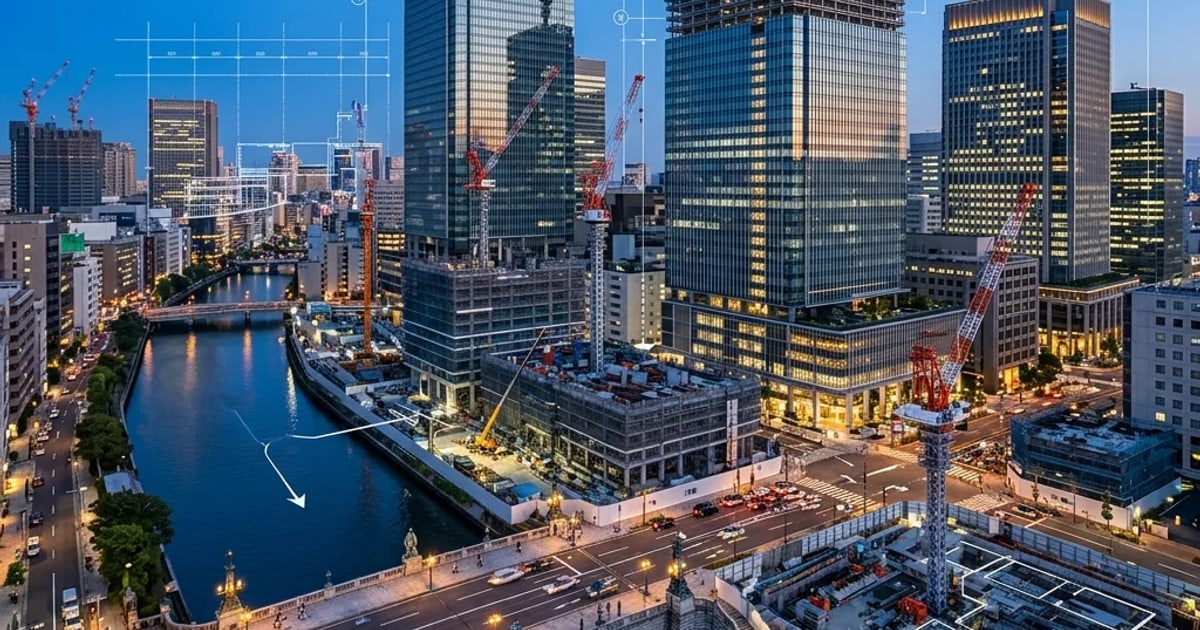
The district comprises over a dozen separate redevelopment zones orchestrated primarily by Mitsui Fudosan, each designed to connect with the others through underground passages, pedestrian decks, and riverside promenades. Evaluating any single building without its pedestrian and transport context underestimates both the upside potential and the execution risk. The thesis is that interconnected mixed-use clusters generate higher aggregate footfall, longer dwell time, and stronger rent power than isolated towers—but only if the linkages are completed and maintained.
The scale is significant. The Nihonbashi 1-Chome Central District project—a 52-story flagship tower featuring offices, luxury retail, MICE facilities, the Waldorf Astoria Tokyo Nihonbashi hotel (floors 39–47), and Waldorf Astoria Residences (floors 48–51)—is scheduled for completion around March 2026, with overall project completion targeted for September 2026.3 This single development will add a new gravity center to the district’s eastern edge, pulling foot traffic patterns away from the established COREDO Muromachi axis toward the river.
Beyond the flagship, the Nihonbashi Honcho M-SQUARE targeted completion in November 2025, and the Nihonbashi Honcho 1-chome District 5 project broke ground in November 2025. The “Nihonbashi River Walk Area Management” organization was established in April 2025 to coordinate cohesive development across five major redevelopment zones along the Nihonbashi River—a signal that the project has moved from individual-tower execution to integrated district management.
2. Three practical axes: flow, resilience, dwell time
I read Nihonbashi pipeline updates through three lenses that together determine whether the district story converts from developer narrative to investable reality:
Axis 1: Flow — Are pedestrian routes becoming stickier?
The most underappreciated driver of urban retail and office rent premiums is pedestrian circulation quality. Nihonbashi’s redevelopment is fundamentally a circulation redesign: underground connections linking subway stations (Mitsukoshimae, Nihonbashi, Shin-Nihonbashi) to tower lobbies and retail arcades, riverfront promenades replacing highway underpasses, and weather-protected walkways enabling year-round pedestrian connectivity.
What I observe on the ground: the opening of each new underground passage measurably changes foot-traffic patterns. When COREDO Muromachi Terrace connected to the Muromachi 1-chome pedestrian network, lunchtime restaurant traffic redistributed within weeks. This is the micro-level evidence that flow engineering works. The investment implication is that properties with direct underground-passage access trade at persistent premiums over comparable properties one block outside the network—and that premium widens as more nodes connect.
Axis 2: Resilience — Do infrastructure upgrades improve continuity in stress events?
Tokyo’s disaster-preparedness infrastructure is a real but often overlooked component of real estate value. Nihonbashi’s redevelopment includes seismic base isolation across major new towers, emergency power generation for multi-day grid independence, floodwall integration along the Nihonbashi River, and designated evacuation spaces within commercial complexes.1
For office tenants, especially financial institutions and multinational headquarters, BCP (Business Continuity Planning) certification is increasingly a lease-decision factor. Buildings that can demonstrate 72-hour autonomous operation after a major seismic event command 5–10 percent rent premiums over comparable space without those certifications. As the cluster of BCP-certified buildings in Nihonbashi grows, it creates a “resilience district” network effect—companies can relocate employees between buildings within the same area with minimal disruption, which is a capability that isolated towers cannot offer.
Axis 3: Dwell time — Are mixed-use elements extending time in-area?
The third axis measures whether Nihonbashi is becoming a place people stay longer, rather than merely transit through. The combination of hotel rooms (Waldorf Astoria, existing Mandarin Oriental), retail (COREDO complex, artisan food halls), cultural programming (Nihonbashi Mitsui Hall, historical walking tours), and residential towers (Nihonbashi riverfront residences) creates a layered demand profile by time of day:
- Morning: Office workers and hotel guests arriving
- Midday: Retail shoppers and restaurant patrons
- Evening: Cultural event attendees, dining, hotel guests
- Weekend: Tourist foot traffic, residential community activity
When all three axes move together—circulation improves, resilience certifications expand, dwell-time activities deepen—the combined effect on rents and property values is non-linear. Individual improvements are incremental; the network is multiplicative.
3. Distinguish narrative decks from operating evidence
Developer presentations for Nihonbashi are polished, data-rich, and directionally useful—but they are not investment evidence. I have seen enough urban redevelopment cycles to know that timeline slippage, cost overruns, and tenant-mix pivots are the norm, not the exception.
What I cross-check against:
- Public planning filings. MLIT publishes national land and urban policy frameworks that constrain or enable FAR bonuses, height exceptions, and public-space requirements. Tokyo Metropolitan Government publishes city-level planning approvals and infrastructure commitments. These provide the regulatory envelope within which developer ambitions must operate.
- Actual leasing and retail behavior. I walk the COREDO Muromachi complex regularly and note tenant turnover, vacancy signs, and foot-traffic density. Retail vacancy in completed phases is the ground truth; pre-lease announcements for future phases are forecasts.
- Construction progress versus disclosed schedules. The magnitude of the Metropolitan Expressway underground relocation—targeted for the 2030s, which will eventually open riverfront views and eliminate highway noise for the entire district—is a multi-decade catalyst. But “targeted for the 2030s” means significant timeline uncertainty, and pricing that catalyst today requires explicit assumptions about delay probability and interim rent trajectories.2
4. Investment translation: from story to spreadsheet
For the Nihonbashi thesis to move from narrative to actionable, I translate redevelopment stories into measurable assumptions:
| Variable | Base Case | Stress Case | How to Track |
|---|---|---|---|
| Absorption pace (new office space) | 85–90% pre-leased at opening | 70% at opening, 18-month stabilization | CBRE / JLL quarterly vacancy reports |
| Rent uplift (completed vs. pre-redevelopment) | +15–25% for Grade A in-network | +5–10% if macro headwinds dominate | MLIT rent survey, REINS comps |
| Cost overrun buffer | 10–15% above disclosed budget | 25%+ if materials/labor spike | Construction cost index (建設物価) |
| Timeline execution | On schedule (±6 months) | 12–24 month delay | Developer IR filings, MLIT progress reports |
| Expressway relocation catalyst | 2032–2035 partial benefit | Post-2035, limited near-term impact | Tokyo Metro Government infrastructure timeline |
If these variables are not explicit in your thesis, the investment case is still at marketing level. I require at least two of the five variables to show positive evidence from observable data (not projections) before treating the theme as actionable rather than aspirational.
5. Position sizing for long-cycle themes
Nihonbashi is inherently a long-cycle compounding theme. The district has been under active redevelopment since the early 2000s—the original COREDO Nihonbashi opened in 2004—and the master plan extends through the 2030s and beyond. This means that the payoff is not a binary event but a gradual accretion of value as network effects strengthen.
Position sizing should reflect timeline uncertainty, not just conviction in the destination. I apply three principles:
- Size for the stress case, not the base case. If your allocation to Nihonbashi-exposed assets would cause portfolio pain in a delayed-timeline scenario (expressway relocation pushed to 2038, absorption slower than expected), the position is too large.
- Use observable milestones for rebalancing triggers. Each project completion (Nihonbashi 1-Chome tower delivery in 2026, Honcho District 5 completion, expressway relocation commencement) provides new evidence. Increase allocation only when evidence confirms timeline, not when narrative excitement peaks.
- Diversify the expression. Direct real estate ownership, J-REIT holdings with Nihonbashi exposure (Mitsui Fudosan’s affiliated REITs hold significant Nihonbashi assets), and indirect plays through Mitsui Fudosan equity all offer different risk-return profiles and liquidity structures. Concentrating in a single vehicle amplifies execution risk.
The beauty of this theme is its durability—Nihonbashi has been Japan’s commercial heart for four centuries, and the current redevelopment is extending rather than inventing that identity. But durability of theme does not guarantee durability of returns. The discipline is in distinguishing between the story (which is compelling) and the math (which must be tested against adversity before capital is committed).
Data freshness (April 2026): BOJ policy rate 0.75 %, 10-year JGB ≈ 2.43 %, TSE REIT Index ≈ 1,916, Tokyo 5-ward vacancy 2.22 % (Miki Shoji Q1 2026), Q1 2026 inbound tourists 10.68 M (JNTO). Verify the latest from linked sources before acting.
Investor Action: Session Summary & Check
- Pipeline: Monitor the tenant status and rental spillover effects of the ‘Nihonbashi 1-Chome Central’ project due for completion in 2026.
- Synergy: Analyze the potential asset value appreciation in the ‘Tokyo Finance Belt’ connecting Kabutocho and Nihonbashi.
- Holding: If you own small mansions or REITs near Nihonbashi, review your long-term holding strategy until the 2030 completion of the underground expressway.
Further reading in this series
- Tokyo office vacancy: five wards, 2026 view
- Small rental yield vs capital gain breakeven
- Japan rate-hike cycle: three J-REIT lessons

![Tokyo Core 3 Ward Home Prices — Chiyoda, Chuo & Minato [Ep.1·2026]](https://gsfark.com/assets/images/blog/tokyo-core-3-wards-chiyoda-chuo-minato-hero-og.jpg)
![Shinjuku, Shibuya & Bunkyo Home Prices and Living Profiles [Ep.2·2026]](https://gsfark.com/assets/images/blog/tokyo-shinjuku-shibuya-bunkyo-hero-og.jpg)
![Where Are Setagaya's Affluent Areas? — Seijo & Meguro Property Prices [Ep.3·2026]](https://gsfark.com/assets/images/blog/tokyo-meguro-setagaya-hero-og.jpg)