※ This article is for informational purposes and personal analysis only—not investment, legal, tax, or immigration advice, and not a recommendation to buy or sell any property or financial product. Verify figures, rules, and market data against official sources and consult qualified professionals; you are solely responsible for your decisions. Information reflects the time of writing and may change afterward.
The image of Japan as a “Closed Country” is becoming a thing of the past. To combat a shrinking population, the Japanese government has introduced some of the most competitive immigration routes in Asia. From the 1-year Permanent Residency fast-track to the newly launched J-Find visa for elite graduates, the barrier to entry has shifted from “Can I enter?” to “Which route is the most efficient for my assets?”
Today, we analyze the three primary routes for investors and professionals looking to establish a base in Japan in 2026.
1. The ‘Business Manager’ Visa: 2025/2026 Modernization
This is the traditional route for those setting up a real estate management company or a startup.
- Financial Requirement: A minimum capital of 5 million JPY was the old standard. In 2025, there has been increasing scrutiny on the “Business Continuity” and “Physical Office” requirements. For serious investors, a capital of 30 million JPY is often recommended to demonstrate financial stability and secure a longer-duration visa (3 or 5 years) on the first attempt.1
- Office Requirement: A “Virtual Office” is generally not accepted. You must have a physical office space with a separate entrance and a clear business sign.
- Expansion (2024 Reform): Foreigners can now stay for up to 2 years without a physical office or capital if they are in the process of starting a business in certain “National Strategic Special Zones.”
2. Highly Skilled Professional (HSP) & The 1-Year PR Track
Japan’s “Point System” is one of the fastest routes to Permanent Residency (PR) in the world.
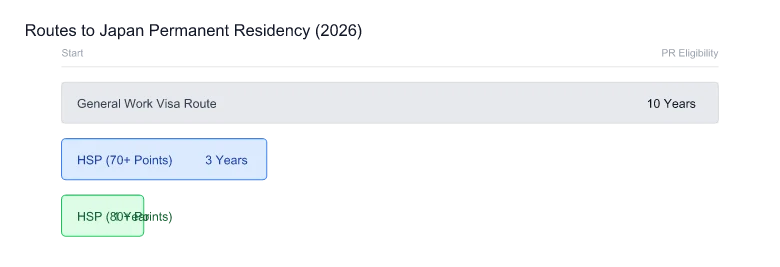
- The 70-Point Threshold: If you score 70 points based on your academic background, career, and income, you can apply for PR after 3 years.
- The 80-Point Fast-Track: If you score 80 points or higher, the waiting period for PR drops to just 1 year.2
- Income Requirement: For those in the “Business Management” HSP category, a minimum annual salary of 10 million JPY (paid by your Japanese entity) is often the baseline to secure the necessary points.
3. PR Timeline Visualization
4. J-Find and J-Skip: Targeting the Global Elite
- J-Find: Graduates from the world’s top 100 universities (based on major rankings) can stay in Japan for up to 2 years to look for a job or start a business, with minimal initial requirements.
- J-Skip: High-income earners (20M JPY+ per year) or those with advanced degrees and 5+ years of experience can bypass the complex point system and secure an HSP visa directly, qualifying for the 1-year PR track.
5. Strategy for Investors: Leveraging Real Estate
Can you get a visa just by buying real estate? No. Japan does not have a direct “Golden Visa” for property purchases.
However, if you establish a Real Estate Management Company, hire necessary staff (or outsourcing partners), and manage a portfolio that generates enough revenue to pay yourself a qualifying salary, you can secure a Business Manager Visa. This structure allows your investment to become the foundation for your residency.3
At GSF, we help investors build the business substance required to turn a property portfolio into a legitimate visa path.
Data freshness (April 2026): BOJ policy rate 0.75 %, 10-year JGB ≈ 2.43 %, TSE REIT Index ≈ 1,916, Tokyo 5-ward vacancy 2.22 % (Miki Shoji Q1 2026), Q1 2026 inbound tourists 10.68 M (JNTO). Verify the latest from linked sources before acting.
Investor Action: Session Summary & Check
- Score: Calculate your points for the Highly Skilled Professional (HSP) visa based on education, experience, and salary.
- Capital: Prepare source-of-funds evidence for the capital (5M JPY minimum, 30M JPY recommended for stability) required for a Business Manager visa.
- Stay: If aiming for permanent residency, ensure your annual days outside Japan do not exceed the requirement (typically <100 days).
Recommended Series
- Cross-Border Inheritance Tax: The 10-Year Rule
- Corporate vs Personal Ownership: Tax Comparison
- Tokyo 5 Wards Office Market Analysis 2026

![Is Nishitokyo Priced Like the 23 Wards? — Kodaira & Koganei Transaction Prices [Ep.13·2026]](https://gsfark.com/assets/images/blog/tokyo-nishitokyo-kodaira-koganei-hero-og.jpg)
![Tokyo Core 3 Ward Home Prices — Chiyoda, Chuo & Minato [Ep.1·2026]](https://gsfark.com/assets/images/blog/tokyo-core-3-wards-chiyoda-chuo-minato-hero-og.jpg)
![Shinjuku, Shibuya & Bunkyo Home Prices and Living Profiles [Ep.2·2026]](https://gsfark.com/assets/images/blog/tokyo-shinjuku-shibuya-bunkyo-hero-og.jpg)