
※ This article is for informational purposes and personal analysis only—not investment, legal, tax, or immigration advice, and not a recommendation to buy or sell any property or financial product. Verify figures, rules, and market data against official sources and consult qualified professionals; you are solely responsible for your decisions. Information reflects the time of writing and may change afterward.
A Korean resident selling Japanese property should first check Japan’s non-resident capital gains rules and the general 10.21% withholding requirement. In Korea, foreign-asset capital gains rules can apply to a resident who has maintained an address or residence in Korea continuously for at least five years by the sale date. Eligible Japanese tax may be handled through a capped credit or a deductible-expense election. Confirm the holding period, buyer’s use, and both filing calendars before signing.
Even for the same sale, Japan and Korea apply different tests.
At a Glance
Korean Resident
      │
      ▼
Japanese Property Sale
      │
      ▼
① Confirm Japanese withholding tax requirements
      │
      ▼
② File Japanese tax return
      │
      ▼
③ Report capital gains in Korea
      │
      ▼
④ Claim Foreign Tax Credit
How Does Japan Classify Short- and Long-Term Property Gains?
Under Japanese tax law, capital gains from individual real estate transfers are subject to classified taxation (分離課税), meaning they are calculated and taxed independently from other income. The primary factor in determining the tax rate is the holding period.
Tax rates differ significantly depending on whether the property is held for 5 years or less (short-term) or more than 5 years (long-term). Simply calculating the calendar period between the acquisition date and the sale date can lead to costly tax mistakes.
Most assume the five years run simply from the acquisition date. The actual test is a little different.
The “January 1 Rule”
According to National Tax Agency (NTA) regulations, the holding period is evaluated as of January 1 of the year in which the sale occurs, rather than the actual transaction date. 1
In practice, think of it as calculating the holding period as of January 1 of the sale year.
For example, if a property purchased on May 1, 2021 is sold on June 1, 2026, the calendar holding period exceeds five years. However, as of January 1, 2026, the holding period is still approximately four years and eight months — meaning only four January 1sts have passed (2022, 2023, 2024, 2025) since acquisition. Therefore, this transaction is treated as a Short-term Capital Gain.
GSF Note
A more common mistake than applying the wrong tax rate is miscalculating the holding period.
In Japan, the threshold is not simply five years from the acquisition date — it is determined based on January 1 of the year of sale.
If the transfer date could fall on either side of year-end, the classification may change, so review the transaction timeline together with the tax plan.
National Tax Rates for Non-Residents
The figures below are the Japanese national rates, including the special reconstruction income tax, for a seller treated as a non-resident. Any local inhabitant tax exposure depends on the seller’s address, residence, and relevant assessment date and should be checked separately.
- Short-term Capital Gains (5 years or less as of Jan 1): Tax rate of 30.63% applies 2
- Long-term Capital Gains (exceeding 5 years as of Jan 1): Tax rate of 15.315% applies 3
Because the classification is tested on January 1 of the sale year, a transfer that moves into a new calendar year should be reviewed as part of the tax plan.
When Is 10.21% Withheld from the Sale Price?
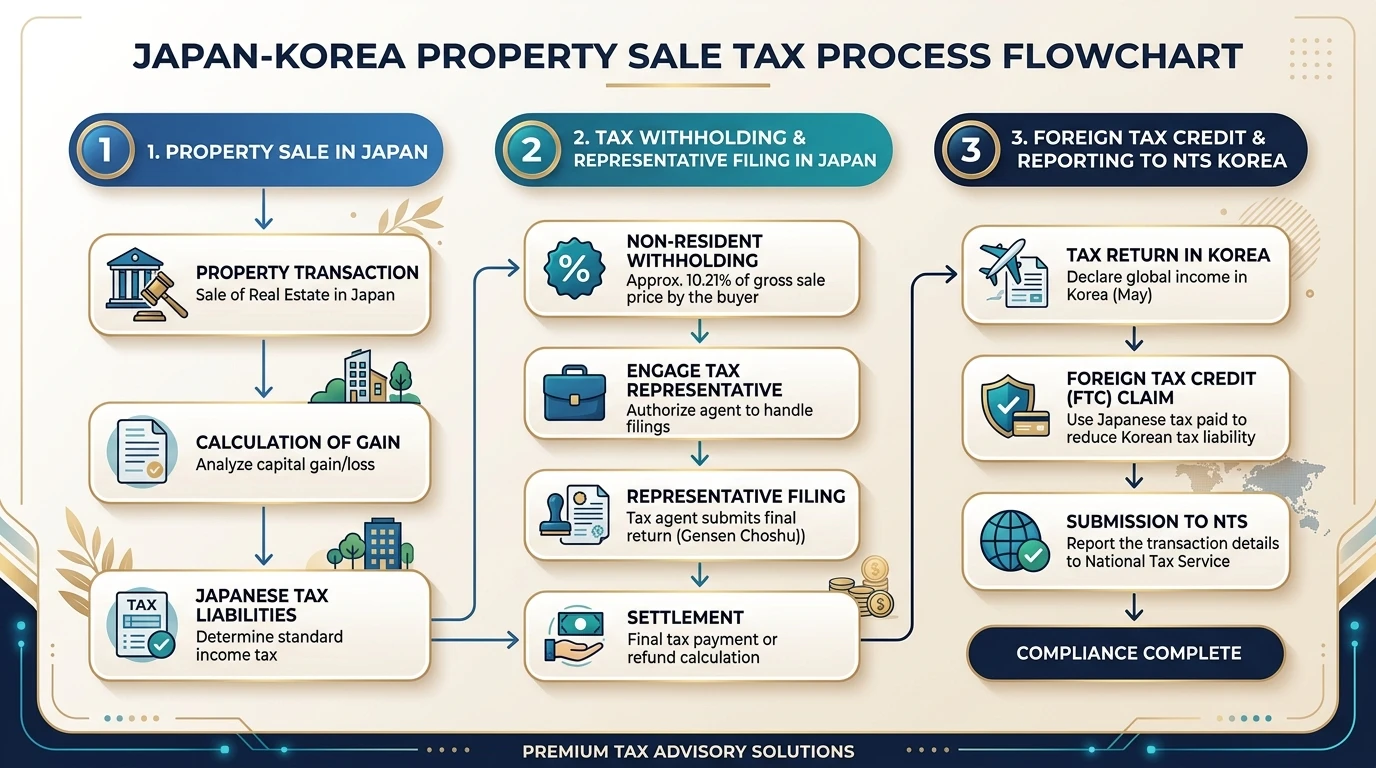
Japanese tax law requires withholding tax at settlement to reduce the risk of tax collection becoming difficult after a non-resident seller receives the sale proceeds.
Withholding Tax on Land and Building Transfers
In principle, the buyer is required to withhold 10.21% of the gross purchase price (not the net gain) when paying a non-resident seller. 4 This applies to the transfer of land and buildings (土地等の譲渡対価). Condominiums with land rights are generally included. Since a significant portion of the sale proceeds is withheld at closing, sellers need to prepare for this temporary cash-flow restriction on closing day.
Three Criteria for Withholding Tax Exemption
The withholding tax obligation is waived if the transaction meets all three of the following conditions: 4
- The buyer is an individual (not a corporation).
- The buyer or their relatives use the property as their primary residence.
- The total sale price is 100,000,000 JPY or less.
If the property is sold to a corporation or an investor who does not plan to reside there, the 10.21% withholding tax will apply.
Filing Through a Tax Representative
The 10.21% withheld at closing is not the final tax amount. Non-resident sellers must file a Japanese income tax return (確定申告) between February 16 and March 15 of the year following the sale. 5
The final liability is calculated after allowable acquisition costs and transfer expenses. If withholding exceeds the final amount, the seller may claim a refund. A non-resident required to file must appoint a Tax Representative (納税管理人) and notify the competent tax office before submitting the return. 5
What Changes When a Corporation Owns the Property?
If a property is owned under a corporate structure rather than individually, the tax rules at the exit phase are completely different.
Corporations do not use the individual’s short- versus long-term capital gains classification. Sale gains and losses are calculated with other corporate income for the fiscal year, while applicable national and local rates vary by factors such as company size, location, and income. The after-tax result therefore requires entity-specific calculation. For comparison points, see Japanese Property Corporate vs. Individual Post-Tax Yield Comparison.
Who Must File in Korea, and How Does Foreign Tax Relief Work?
Article 13 of the Japan–Korea Tax Convention permits Japan to tax gains from Japanese immovable property. 9 Korea’s foreign-asset rules cover a resident who, by the transfer date, has continuously maintained an address or residence in Korea for at least five years. 7 Do not infer a Korean filing obligation from the label “Korean resident” alone; confirm this five-year condition and the individual’s residence status.
Reporting Schedule and Tax Rates in Korea
- Preliminary Return: The taxpayer needs to file a preliminary return and pay the tax within 2 months from the end of the month in which the transfer date falls. 7 Generally, if the taxpayer has only one foreign property transfer and files a preliminary return, the final consolidated return in May of the following year is waived. 7
- Tax Rate: The taxable amount and rate follow Korea’s rules for foreign assets. Domestic-home exemptions or surcharge rules should not be copied across without checking their scope.
Eliminating Double Taxation: The Foreign Tax Credit
It’s easy to assume that Japanese tax paid is simply recognized in Korea, but it is only creditable up to the statutory limit. Where both countries tax the gain, Article 118-6 of Korea’s Income Tax Act allows an election between a capped Foreign Tax Credit (외국납부세액공제) and treating eligible foreign tax as a deductible expense. The credit method reduces Korean capital gains tax only up to the statutory limit. 8
[!WARNING] Limits of the Foreign Tax Credit Under the credit method, eligible Japanese tax paid or payable is creditable only up to Korea’s statutory limit. Amounts above the limit or outside the eligibility rules may not be fully offset. The deductible-expense election should be compared using the taxpayer’s actual figures.
GSF Note
Comparing the two systems, the filing date mattered more than the filing order.
The Japanese and Korean filing deadlines may not align. If the Japanese amount is not final when the Korean return is due, confirm whether the case calls for an initial claim, supplemental evidence, or an amended claim with the competent office or an adviser.
Furthermore, exit tax matters are linked to inheritance and gift tax planning. To understand the basics of cross-border asset transfers, refer to the Korea-Japan Inheritance and Gift Tax Cross-Border Guide.
What Should You Prepare Before the Sale?
A step-by-step checklist from contract signing through Korean tax filing.
Pre-Contract
- Verify Holding Period: Confirm whether January 1 of the sale year crosses the 5-year threshold — prevents short-term tax rate application
- Check Withholding Tax Applicability: Determine if the 10.21% withholding applies based on the buyer’s profile (corporation or investor individual)
- Estimate Net Proceeds: Calculate after-tax proceeds using acquisition cost, capital expenditures, and transaction fees. Refer to the Rental Yield vs. Capital Gain Breakeven Guide
- Prepare Required Documents: Gather acquisition contract, capital expenditure receipts, and identify tax representative candidates
Closing Day
- Final Withholding Tax Confirmation: Reconfirm buyer eligibility before settlement
- Verify Actual Transfer Amount: Compare actual proceeds received against estimate after 10.21% deduction
- Retain All Settlement Documents: Keep digital copies of all closing-related contracts and receipts
Japanese Tax Return (Year Following Sale, Feb–Mar)
- Appoint and Register Tax Representative: File the representative notification in advance — required for non-residents
- Compile Deductible Expenses: Submit acquisition cost, capital expenditures, and agency fee documentation in full
- File Tax Return and Confirm Refund: Submit return, confirm over-withheld refund amount
- Confirm Refund Receipt: Ensure bank account is set up for refund deposit
Korean Tax Reporting (Within 2 Months from the End of the Month of Sale)
- File Preliminary Return and Pay Tax: Submit to the competent tax office
- Claim Foreign Tax Credit: Attach Japanese final tax payment receipt and file for double taxation relief
- Retain Supporting Documents: Keep contracts, tax receipts, and remittance records from both countries for the applicable statutory period
Which Tax Variables Should Be Checked Before Signing?
Review the Sale Timeline First
If a property is near the five-year threshold, moving the transfer across year-end can change its classification. Rather than relying on a simple day count, confirm the January 1 test with a tax adviser.
Calculate the Actual Cash Flow at Closing First
If withholding tax applies, the actual amount received at closing may be substantially lower than expected. Since any refund is processed after the tax return is filed the following year, short-term liquidity should be factored into the plan as well.
Cross-Border Tax Review Before Signing Is the Prudent Approach
The actual tax liability can vary depending on acquisition cost, deductible expenses, ownership structure, and how the Foreign Tax Credit is applied. Consulting a specialist who handles both Japanese and Korean cross-border tax matters before signing is the recommended approach.
GSF-Ark treats Japanese real estate investment as more than a calculation of rental yields or resale profits. From acquisition and ownership to sale and inheritance, Japanese real estate is part of a long-term asset management process.
This article summarizes the key regulations and procedures Korean residents should be aware of when selling Japanese real estate.
The actual tax liability may vary depending on acquisition cost, deductible expenses, capital expenditures, ownership structure, and how Korean tax law is applied.
Coming back to the opening line, the order of checks stays the same. Confirm each country’s own test date first, then calculate the rate and the credit. Reversing that order is where mistakes creep in.
Before completing a transaction, reviewing your individual situation with a cross-border tax professional in both Japan and Korea is the recommended approach.
Data Reference Point
- The tax treatments and cross-border guidance in this article are current as of July 4, 2026, based on active tax codes and guidelines from the NTA and NTS. Individual tax requirements may differ due to treaty revisions or legislative changes. Tax laws may change over time. Before completing an actual transaction, always confirm the latest regulations and seek professional advice where appropriate.

![Is Nishitokyo Priced Like the 23 Wards? — Kodaira & Koganei Transaction Prices [Ep.13·2026]](https://gsfark.com/assets/images/blog/tokyo-nishitokyo-kodaira-koganei-hero-og.jpg)
![Tokyo Core 3 Ward Home Prices — Chiyoda, Chuo & Minato [Ep.1·2026]](https://gsfark.com/assets/images/blog/tokyo-core-3-wards-chiyoda-chuo-minato-hero-og.jpg)
![Shinjuku, Shibuya & Bunkyo Home Prices and Living Profiles [Ep.2·2026]](https://gsfark.com/assets/images/blog/tokyo-shinjuku-shibuya-bunkyo-hero-og.jpg)