※ This article is for informational purposes and personal analysis only—not investment, legal, tax, or immigration advice, and not a recommendation to buy or sell any property or financial product. Verify figures, rules, and market data against official sources and consult qualified professionals; you are solely responsible for your decisions. Information reflects the time of writing and may change afterward.
1. Why headline yield often overstates reality
Small-unit investment condominiums—typically 18–25 square meter 1R or 1K formats in central Tokyo—are the entry point for many individual investors. They are marketed aggressively by developers and brokerage firms, almost always with a “surface yield” figure (表面利回り) prominently displayed: 4.0%, 4.5%, sometimes 5.0% or higher in secondary locations.1
I have underwritten enough of these deals to know that the gap between surface yield and realized net return is where most investment theses quietly die. Here is what the headline number almost never includes:
- Vacancy churn. Compact units serving single tenants (university students, young professionals, company-housed workers) have shorter average tenancy than family-sized apartments. In central Tokyo, average occupancy cycles of 2–3 years are common, with 1–2 months vacancy per turnover for cleaning, minor repair, and re-listing. On a small-unit basis, one month of vacancy equals roughly 8% of annual gross income—and two turnovers per five-year period can reduce cumulative yield by 15–20% versus the “zero vacancy” assumption in surface yield calculations.
- Maintenance and repair spikes. Air conditioning units in compact apartments need replacement every 8–12 years (¥80,000–150,000). Water heaters fail on similar cycles. Flooring and wallpaper refreshes at turnover cost ¥50,000–100,000 per event. These are not catastrophic individually, but they cluster unpredictably and are not captured in any annual yield calculation.
- Fee drag. Monthly management fees (管理費) and repair reserve contributions (修繕積立金) for investor-oriented compact buildings typically run ¥8,000–18,000 combined. For a unit generating ¥70,000–90,000 monthly gross rent, this is 10–25% of top-line revenue consumed before any other costs.
- Tax friction. Income tax on rental income (at marginal rates for Japanese residents, with withholding obligations for non-residents), fixed asset tax and city planning tax, and the consumption tax treatment of management fees all erode net returns. Foreign investors face additional complexity around tax treaty benefits, filing obligations, and withholding mechanics.
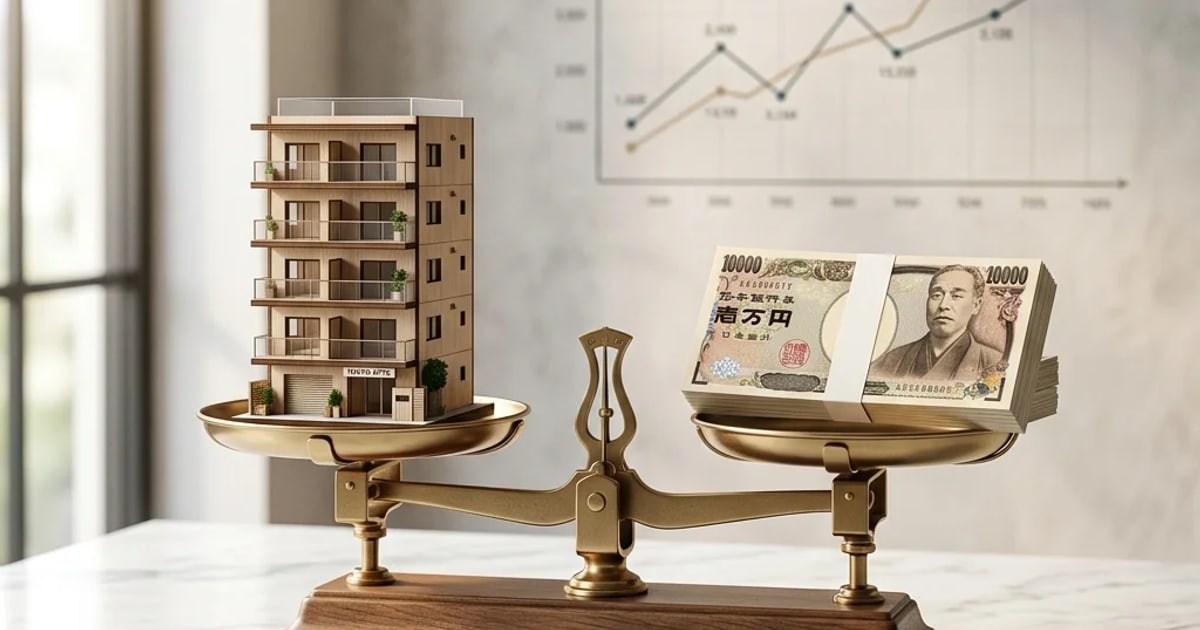
A realistic full-cycle analysis often shows that a property marketed at “4.5 percent surface yield” delivers 1.5–2.5 percent net after all frictions.2 If mortgage debt service is layered on top, the levered cash yield can approach zero in the early years—meaning the entire return thesis rests on price appreciation.
2. Breakeven is a scenario range, not one number
I model breakeven with three explicit paths, because a single-point estimate gives false confidence:
Base case: gradual appreciation + modest positive cash flow
- Purchase at ¥25,000,000, financing at 1.5% variable rate, 75% LTV
- Gross rent ¥85,000/month, vacancy allowance 5%
- Net cash flow after tax and all costs: approximately ¥120,000–180,000/year positive
- Required appreciation for 10-year IRR target of 4%: approximately 8–12% cumulative (less than 1% annually)
This base case is achievable in the current market—Tokyo condo prices have been rising faster than this threshold—but it assumes no material rate increase, stable tenant demand, and normal maintenance costs.
Stress case: rates up + flat pricing
- Same acquisition, but financing rate rises to 2.5% within three years (BOJ continuing normalization)
- Rent growth flat (reflecting a demand softening or oversupply in compact segments)
- Net cash flow turns negative by year 3: approximately ¥-80,000 to ¥-150,000/year
- Required appreciation to avoid overall loss at year 10: approximately 15–20% cumulative
This scenario is not extreme—a 100 basis point rate increase over three years is within the range of BOJ guidance. If pricing also stalls, the investor is paying out of pocket to hold an asset with uncertain exit value.
Weak-exit case: forced sale in a thin market
- Rates elevated, pricing flat or declining, and the investor needs to exit due to life-event liquidity needs
- Disposal costs (agent commission 3%, capital gains tax up to 39.63% for short-term or 20.315% for long-term, miscellaneous) consume 5–10% of sale price
- In a market where comparable listings have accumulated, achieving asking price may require 3–6 months of listing time or a 5–10% discount to ask
The breakeven framework is not about predicting which scenario will occur—it is about knowing in advance how much you lose in each one and whether you can absorb that loss without disrupting your broader financial position.
3. Link rates, FX, and liquidity explicitly
Small-unit investment economics sit at the intersection of three macro variables that most property-level analyses treat in isolation:
Interest rates. In the case of interest rates, as the Bank of Japan (BOJ) raised the policy rate to 0.50% in early 2025 and has signaled further normalization. Variable-rate mortgages—which account for the majority of investment property financing in Japan—reprice with a lag, but each 25 basis point increase adds approximately ¥5,000–7,000 per month to debt service on a typical loan.3 For a compact unit with ¥70,000 gross rent and tight margins, three rate hikes can flip net cash flow from positive to negative.
FX dynamics. For Korean or other foreign investors, yen-denominated returns must be converted back to home currency. A property generating positive yen-denominated cash flow can still deliver negative KRW returns if the yen weakens during the holding period. Conversely, yen appreciation creates translation gains on top of property returns. I model three explicit FX paths (discussed in detail in my FX scenarios post) and require the investment to survive at least two of three.
Domestic liquidity conditions. The compact investor unit market is heavily intermediated by specialized Japan brokerages that target domestic salaried workers (サラリーマン大家). When financing conditions tighten or stock market volatility spikes, this buyer pool contracts—and since compact units have fewer potential owner-occupier buyers than family apartments, exit liquidity is disproportionately sensitive to investor sentiment cycles.
4. Structural context: supply, demographics, and regulatory rails
Beyond property-level underwriting, several structural factors frame the small-unit investment thesis:
Supply constraints. New condominium supply in the Greater Tokyo Area hit its lowest level in half a century in the most recent fiscal year. Construction labor shortages, elevated material costs, and land acquisition difficulty in central wards have structurally reduced the new-build pipeline. This places a replacement-cost floor under existing inventory—a builder cannot profitably construct a new compact unit in central Tokyo for less than the replacement cost, which means existing stock trades below replacement cost in many locations. This does not guarantee appreciation, but it reduces the risk of supply-driven price collapse.
Demographic tailwinds for compact housing. Japan’s demographic decline is a headline headwind, but the relevant variable for central Tokyo compact units is single-person household formation—which has been increasing due to delayed marriage, urbanization of young workers, and corporate relocation patterns. Tokyo’s resident population continues to grow even as Japan’s national population shrinks. The Japan National Institute of Population forecasts that single-person households will represent over 40 percent of all households by 2040, concentrated in urban areas.
Regulatory context. MLIT sets the regulatory framework for building standards, leasing rules, and transaction disclosure requirements. The National Tax Agency administers income and capital gains taxation for both residents and non-residents. Understanding depreciation schedules (RC buildings: 47-year statutory life, with accelerated depreciation available for certain investor structures) is critical for after-tax return modeling—depreciation deductions can significantly improve near-term cash-flow economics even when headline yields are thin.
5. If it only works in one scenario, it’s speculation
The discipline I apply to any small-unit deal: if the investment requires the base case (moderate appreciation, stable rates, full occupancy) to be correct in order to generate acceptable returns, it is a speculation, not a robust income strategy.
A properly structured small-unit investment should meet three criteria:
- Survival in the stress case. Annual out-of-pocket cost under stressed rates and flat pricing should be small enough to carry from other income for at least 3–5 years without lifestyle impact.
- Positive IRR in two of three scenarios. The base case and at least one alternative path (either the stress case with eventual exit appreciation, or the weak-exit case with favorable carrying yield through the hold period) should show positive returns.
- No forced-selling triggers. Financing must be structured with adequate rate-rise buffers, and the investor’s overall balance sheet should not depend on timely exit from this specific position.
Small-unit investing in Tokyo can be a sensible component of a diversified portfolio, especially for investors with yen-denominated income, long time horizons, and the ability to manage properties directly or through trusted management companies. But the entry point for disciplined analysis is the breakeven spreadsheet, not the sales brochure.
Data freshness (2026-04-01): BOJ policy rate 0.75%, 10-year JGB ≈ 2.43%, TSE REIT Index ≈ 1,916, Tokyo 5-ward vacancy 2.22% (Miki Shoji Q1 2026), Q1 2026 inbound tourists 10,680,000 (JNTO). Verify the latest from linked sources before acting.
Investor Action: Session Summary & Check
- Breakeven: Calculate the point where ‘net profit’ (including annual maintenance and taxes) is outweighed by asset appreciation.
- Taxation: Simulate the optimal exit timing by comparing long-term hold tax benefits vs. short-term capital gains penalties.
- Alternatives: Compare after-tax effective yields between direct small-mansion investment and J-REITs to suit your capital scale.
Further reading in this series
- Tokyo office vacancy: five wards, 2026 view
- Small rental yield vs capital gain breakeven
- Japan rate-hike cycle: three J-REIT lessons

![Tokyo Core 3 Ward Home Prices — Chiyoda, Chuo & Minato [Ep.1·2026]](https://gsfark.com/assets/images/blog/tokyo-core-3-wards-chiyoda-chuo-minato-hero-og.jpg)
![Shinjuku, Shibuya & Bunkyo Home Prices and Living Profiles [Ep.2·2026]](https://gsfark.com/assets/images/blog/tokyo-shinjuku-shibuya-bunkyo-hero-og.jpg)
![Where Are Setagaya's Affluent Areas? — Seijo & Meguro Property Prices [Ep.3·2026]](https://gsfark.com/assets/images/blog/tokyo-meguro-setagaya-hero-og.jpg)