※ This article is for informational purposes and personal analysis only—not investment, legal, tax, or immigration advice, and not a recommendation to buy or sell any property or financial product. Verify figures, rules, and market data against official sources and consult qualified professionals; you are solely responsible for your decisions. Information reflects the time of writing and may change afterward.
1. What are the advantages of investing in Japanese real estate?
Explosive Growth and Asset Cycle Transition: Moving beyond simple “stability,” the market has now clearly entered a phase of growth. Although Japan’s economic growth rate remained below 2% over the past 30 years, recently, following the COVID-19 pandemic, mansion (apartment) prices in Tokyo’s core districts have been skyrocketing, breaking historical highs almost every day. Escaping the long swamp of deflation and riding a full-fledged inflationary upward cycle, I firmly believe the Japanese real estate market has transformed into one of the most dynamically re-evaluated asset classes by global capital.
Ownership: Foreigners are permitted to own land and residential property in Japan, which is not possible in many other Asian countries. When it comes to owning real estate, foreign investors can have the same rights as Japanese citizens.
Safe Haven: The Japanese real estate market is evaluated as one of the safest markets in Asia. It is highly reputed as an attractive place to invest due to its reliability.
Tourism demand: Cross-border travel has recovered meaningfully from the pandemic trough, and that can support selected rental and retail corridors. Past peak and early-recovery figures in this article should be read as historical reference points; always confirm current monthly direction with JNTO.
When you sanity-check numbers and policy trends, pair this article with primary materials from the Ministry of Land, Infrastructure, Transport and Tourism (MLIT) and macro releases from Statistics Japan. Nothing here is tax or legal advice—rates and registration practice change, so verify the latest rules with qualified professionals.
2. What are the key legal and tax knowledge you should know?
When investing in real estate in Japan, it is important to equip yourself with knowledge about market trends, legal regulations, and Japanese communication skills, while also understanding real estate-related taxes. Taxes borne by real estate investors in Japan include stamp duty, registration and real estate acquisition taxes, and consumption tax. Excluding the marginal stamp duty, the primary taxes are as follows:
Real Estate Acquisition Tax: This tax is levied on the acquisition of land or buildings. Currently, a 3% basic tax rate applies to land and residential properties, and 4% to non-residential buildings.1 Notably, for residential land (takuchi), the tax base is halved under special relief measures, resulting in an effective tax rate of 1.5% for land and 3% for residential buildings.
Registration License Tax: This is a tax imposed on real estate transactions such as the purchase of real estate or construction of buildings. The amount varies depending on the transaction type and is typically a percentage of the value listed in the official ledger. For example, in the case of a sale, the current registration license tax is 2% of the value recorded in the official ledger.2
Consumption Tax: Consumption tax is a value-added tax levied on the sale of goods and services in Japan, currently set at 10%.3
After purchasing real estate in Japan, there are taxes and miscellaneous expenses that must be paid throughout the ownership period, which include the fixed asset tax and city planning tax. These taxes can be paid at local tax offices, post offices, convenience stores, and financial institutions.
Fixed Asset Tax: A tax paid once a year for the owned real estate. The standard tax rate is around 1.4%.4
Real Estate Income Tax: When you rent out real estate and earn rental income, income tax is levied on that income. Income tax returns must be filed annually. For example, the tax rate is 5% for incomes of 1,950,000 yen or less, and 10% for incomes of 3,300,000 yen or less.
These taxes are mandatory items that investors in Japanese real estate must confirm. It is highly advised to consult with tax or legal experts regarding these specifics. For rates, special measures, and payment mechanics, cross-check MLIT guidance with macro and regional releases from Statistics Japan.
2.1 My own cost-stack worksheet (illustrative SVG)
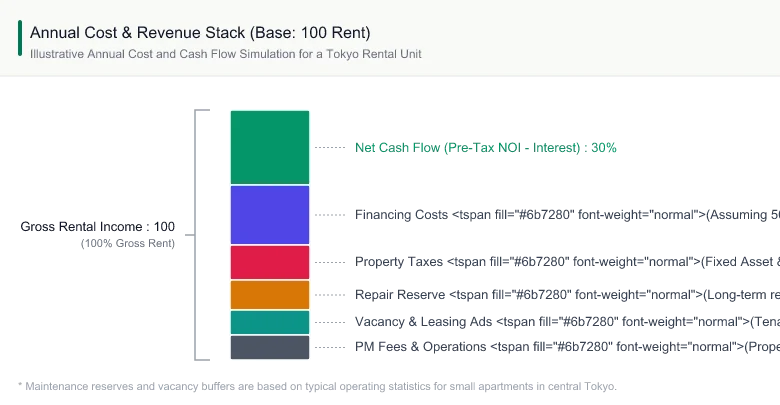
Method note: this chart is a planning worksheet (not a market average). Replace each block with your own property assumptions before using it.
3. Utilizing Local Real estate Networks
Nowadays in investing, digital research is becoming just as crucial as physical scouting. Fortunately, there are reliable platforms we can reference for Japanese real estate investments. In Japan, websites such as Suumo, Homes, At Home, and Real Estate Yahoo are very popular. These websites provide information on properties for sale or rent, and can connect you with local real estate agents who can assist in navigating the market.
Property maintenance and tenant management (in the case of rentals) are just as critical as the purchase itself. Luckily, Japan has well-established professional property management services for this post-purchase phase. While it incurs costs, it is a relatively stress-free environment compared to Korea.
Maintenance: It is critical to maintain the property well to prevent its value from depreciating over time. This includes routine cleaning, repairs, and renovations as needed.
Tenant Management: If you are renting out the property, effective tenant management is paramount. This includes screening tenants prior to move-in, collecting rent on schedule, and resolving any issues that emerge during their residency.
Portal listings are a starting point; pair them with official market context from MLIT and Statistics Japan when you form a view.
Conclusion: Japanese real estate is at the starting point of a new mega-cycle
Many investors still anchor on the long post-bubble period. However, the present backdrop differs in financing conditions, inflation behavior, and tenant demand mix. Alongside equity repricing, selected physical real estate segments in Tokyo have also shown renewed transaction momentum.
After purchasing, Japan’s highly developed professional maintenance and meticulous tenant management services allow investors to comfortably generate stable cash flows. Moving beyond simply securing conservative rental yields like years past, a genuine window of opportunity has opened where I can now actively expect Capital Gains. Of course, thorough review of primary tax and legal regulations remains absolutely indispensable. Moving forward, I will consistently share my sharp and in-depth analytical reports to help seize opportunities amidst this massive paradigm shift in assets.
Further reading in this series
- 5 Things to Know About Investing in Japan REITs (J-REITs)
- Hotel REITs vs Office REITs: Which Recovered More After COVID?
- Japan Rate-Hike Cycles and J-REITs: Three Historical Lessons
Data freshness (2026-04-01): BOJ policy rate 0.75%, 10-year JGB ≈ 2.43%, TSE REIT Index ≈ 1,916, Tokyo 5-ward vacancy 2.22% (Miki Shoji Q1 2026), Q1 2026 inbound tourists 10,680,000 (JNTO). Verify the latest from linked sources before acting.
Investor Action: Session Summary & Check
- Site: Visit the property at least twice at different times to check ‘management state’ and ‘neighbor quality’ beyond the data.
- Interest: Compare variable vs. fixed rate spreads and simulate interest rate hike scenarios over the next 10 years.
- Partner: Remember that the response speed and reporting quality of your local Property Manager (PM) are key to protecting your yield.

![Where Are Setagaya's Affluent Areas? — Seijo & Meguro Property Prices [Ep.3·2026]](https://gsfark.com/assets/images/blog/tokyo-meguro-setagaya-hero-og.jpg)
![Tokyo's 23 Wards Compared — Property Prices & Living Environments [2026]](https://gsfark.com/assets/images/blog/tokyo-ward-guide-series-prologue-hero-og.jpg)