![Is Shin-Okubo Tokyo's Only Koreatown? Cultural, Support & Business Hubs [2026]](https://gsfark.com/assets/images/blog/tokyo-korean-community-beyond-shinokubo-hero-og.jpg)
※ This article is for informational purposes only and is not investment, legal, tax, or immigration advice. Figures, rules, hours, and operational details were accurate when published—verify with official sources before you rely on them.
Shin-Okubo is still the clearest answer if you can only name one Korean district in Tokyo. It’s the first place to look for Korean restaurants, groceries, beauty products, and pop-culture stores in one area.
I expected the story to stop there. Then I checked the Mindan branch list and the location of K-Startup Center (KSC) Tokyo one by one, and one question stayed with me: Is a Koreatown the same thing as a good place for Koreans to live?
The picture looked a little different once I checked. Resident support and business assistance are not concentrated in Shin-Okubo. Mindan operates branches across Tokyo, while KSC Tokyo supports Korean startups from Toranomon.
So this article does not claim that Koreans are concentrated in one place. It separates three different maps: culture and shopping, resident support, and business support.
Why Is Shin-Okubo Still Tokyo’s Main Koreatown?
Let’s answer the opening question first. Shin-Okubo is still Tokyo’s most visible cluster of Korean restaurants, groceries, beauty shops, and cultural retail. That does not make it a map of where Koreans across Tokyo live.
- Culture and shopping: Korean food, beauty, and media are easy to find within a compact district.
- Resident support: For immigration, pensions, tax, inheritance, or legal questions, official services such as Mindan’s consultation center and local branches are more relevant than the shopping district itself.
Are Azabu and Hiroo Korean Community Hubs?
So what about Azabu and Hiroo? With embassies and international schools nearby, I initially assumed wealthy Korean professionals were concentrated there too.
Azabu-Juban and Hiroo are certainly international residential areas with strong access to central Tokyo. But public data alone does not establish them as new Korean residential clusters or private investor networks.
What can actually be verified is one thing: Mindan’s Tokyo headquarters and life consultation center are located in Minami-Azabu, offering guidance on residence status, tax, inheritance, and pensions. My initial assumption and the verifiable facts turned out to be two different things.
Why Do Korean Startups Look to Toranomon?
On to the third map. Toranomon does have an official support base for Korean startups entering Japan.
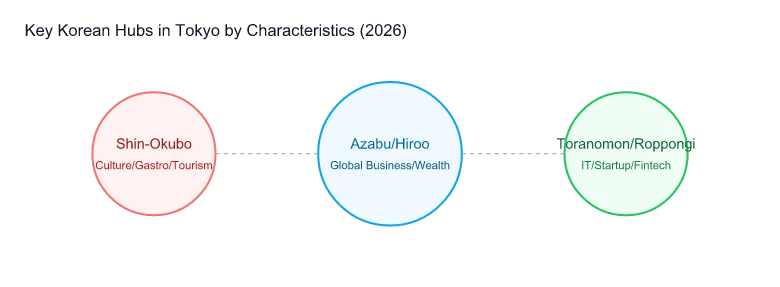
- K-Startup Center Tokyo: KSC Tokyo is located inside CIC Tokyo at Toranomon Hills Business Tower. Its official services include workspace, local investment support, and networking with Japanese companies.
- What this means: It makes Toranomon a practical business-support location for eligible founders. It does not establish the area as a Korean residential neighborhood.
Which Area Should You Check First?
For Korean shopping and dining, Shin-Okubo is the clearest starting point. For resident support, check the nearest Mindan branch and its life consultation service. For Korean startup expansion into Japan, KSC Tokyo in Toranomon is a concrete official contact.
Azabu and Hiroo offer a separate advantage as international residential areas. Available evidence does not justify treating them as Korean enclaves or linking these institutions directly to rising property values.
Three Maps to Keep Separate
- Culture and shopping: Shin-Okubo
- Resident, legal, and tax support: Mindan’s consultation center and local branches
- Korean startup expansion support: KSC Tokyo in Toranomon
Where Can Korean Residents Find Practical Support?
A Koreatown and a suitable place to live are not the same thing. Choose housing by commute, budget, schools, and healthcare first, then locate the Korean-language services you actually need.
If You Prioritize Language Comfort
Shin-Okubo is the easiest place to find Korean groceries, restaurants, and signage in one area. Itabashi has a Mindan branch, but available evidence does not support describing it as a Koreatown comparable to Shin-Okubo.
For residence status, pensions, tax, and inheritance, use a qualified support channel. Mindan’s life consultation center lists lawyers, tax accountants, administrative scriveners, and other specialists, with consultations available by reservation.
If You Prioritize Career and Business Access
If your goal is expanding a Korean startup into Japan, KSC Tokyo in Toranomon is a useful first contact. Its official materials list workspace, local investment support, and networking. Eligibility and current programs should be checked in each notice.
If You Prioritize an International Residential Environment
Azabu-Juban, Hiroo, and Shirokanedai provide access to embassies and international schools. Housing costs and the location of Korean-language services still need separate checks. No public data reviewed here shows that Korean professionals or wealthy residents are disproportionately concentrated in these neighborhoods.
Do Korean Community Hubs Affect Tokyo Property Prices?
The official sources reviewed here do not support that conclusion. KSC Tokyo confirms that Toranomon is a support location for Korean startups entering Japan. It does not prove that Korean residential demand has increased or raised nearby rents.
Mindan branch locations show the same pattern. They confirm a support network, not the size of the Korean population or housing demand in any ward. Property decisions require separate market evidence such as transaction records, asking rents, and vacancy rates.
The question that stayed with me until the end of writing this was simple: can a shopping district and support institutions be read as one map? The answer was no — they are three different maps: a shopping district, a resident-support institution, and a business-support institution.
Collapse them into one, and the change looks bigger than it is. I plan to keep reading these three maps separately going forward. The next time someone says a neighborhood is “full of Koreans,” it’s worth asking which of these three maps they actually mean.
Tokyo Korean Community FAQ
Is Tokyo’s Korean community concentrated only in Shin-Okubo?
Shin-Okubo is the clearest Korean shopping district. Resident support is distributed through Mindan branches, while startup support has a specific base at KSC Tokyo in Toranomon. This does not by itself show a shift in Korean residential concentration.
Is Toranomon the best place for Korean founders to live?
Not necessarily. KSC Tokyo is a business-support contact in Toranomon, but a suitable home depends on commute, budget, and personal needs.
Do these community hubs raise nearby property values?
The available official sources do not establish that link. Community facilities and property-market data should be evaluated separately.

![Japan Rental Contracts: Ordinary vs Fixed-Term Leases & Restoration [2026]](https://gsfark.com/assets/images/blog/tokyo-moving-contracts-two-notes-hero-og.jpg)