※ This article is for informational purposes and personal analysis only—not investment, legal, tax, or immigration advice, and not a recommendation to buy or sell any property or financial product. Verify figures, rules, and market data against official sources and consult qualified professionals; you are solely responsible for your decisions. Information reflects the time of writing and may change afterward.
The returns on Japanese real estate investment are determined by two main gears. One is the value of the asset itself—‘Rental Income and Capital Gains’—and the other is the ‘Exchange Rate’, which serves as the path for liquidation. Even if you achieve a 20% return within Japan, if the value of the Yen has dropped by 20% at the time of remittance, your return in foreign currency becomes zero.
As of 2026, the Yen is experiencing increased volatility near its historical lows. To enjoy the ‘Yen-weakness discount’ while remaining free from the risk of a ‘sudden FX reversal,’ here are three principles every investor should maintain.
1. Don’t ‘Predict’ FX; Build a ‘Response’ Structure
Exchange rates are notoriously difficult even for experts to predict. A simple approach like “I’ll buy when the Yen is cheap and sell when it’s expensive” is closer to speculation than investment. A true investor builds a structure that can defend returns regardless of FX movements.
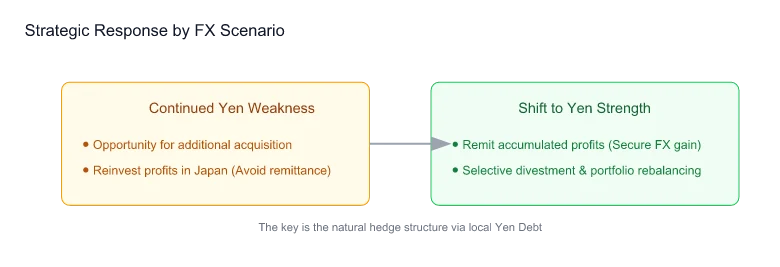
- Leverage Yen Debt (Natural Hedge): By taking a loan from a local Japanese bank (e.g., 50-60% LTV), both your asset value and your debt are denominated in Yen. If the Yen weakens, the value of your asset drops in foreign currency terms, but the value of the debt you owe also decreases. This naturally offsets (hedges) the FX risk on your invested capital.
- Reinvest Yen Earnings: Instead of immediately remitting profits, consider reinvesting or parking them within Japan. This ‘timing diversification’ allows you to wait until the exchange rate is more favorable.
2. Look at the ‘Rate Hike’ Speed Rather Than the ‘Yen Discount’
Many investors say, “Now is the chance because the Yen is cheap.” However, the backdrop of Yen weakness is the interest rate gap between Japan and other major economies. If the Bank of Japan (BOJ) starts raising rates, the Yen will likely strengthen, but property mortgage rates will also rise.
- Check the Yield Spread: If the gap between (Property Yield - Loan Interest Rate) narrows, asset prices face downward pressure. You might enter for the FX gain but get hit by the larger wave of declining asset values (Cap Rate expansion).1
- Focus on Prime Assets: During rate hike cycles, properties in poor locations see their prices drop first. Only high-quality assets, like those in Tokyo’s 5 central wards (Chiyoda, Chuo, Minato, Shinjuku, Shibuya), where rent increases can be passed on to tenants, can withstand the waves of rising interest rates.2
3. Focus on ‘Currency Neutral’ Value
It is essential to train yourself to base investment decisions on the Yen itself, rather than your home currency.
4. Conclusion: “FX is a Bonus; the Core is the Asset”
Thinking that you will make money from FX should be treated as just a potential bonus. The essence of investment is owning a ‘Space’ whose value is preserved or appreciates over time. If what you buy while the Yen is cheap is not just ‘cheap currency’ but ‘real estate in an excellent location,’ your asset will remain steady regardless of where the exchange rate goes in the future.
At GSF, we look past the noise of FX to the intrinsic value of the asset. Use the current Yen weakness as a ‘strategic window’ to diversify your asset portfolio.
Data freshness (April 2026): BOJ policy rate 0.75 %, 10-year JGB ≈ 2.43 %, TSE REIT Index ≈ 1,916, Tokyo 5-ward vacancy 2.22 % (Miki Shoji Q1 2026), Q1 2026 inbound tourists 10.68 M (JNTO). Verify the latest from linked sources before acting.
Investor Action: Session Summary & Check
- Mental: Don’t let FX swings cloud your judgment; judge first if the ‘real value’ of the JPY asset itself has changed.
- Liquidity: Maintain at least a 20% liquid reserve in both KRW/JPY to react to sudden market volatility.
- Auto: Build an automated routine using FX alerts to buy mechanically at your target entry zones.
Recommended Series
- Korea-Japan Inheritance Tax: The 10-Year Rule Trap
- Corporate vs Personal Ownership: Tax Comparison
- Tokyo Office Market 2026: Vacancy and Rent Trends


![How to Invest in Tokyo Real Estate — Steps, Costs and Taxes [2026]](https://gsfark.com/assets/images/blog/tokyo-real-estate-investment-complete-guide-hero-og.jpg)
![Korea–Japan Inheritance Tax: Residency and Japan’s 10-Year Test [2026]](https://gsfark.com/assets/images/blog/korea-japan-inheritance-gift-tax-cross-border-basics-hero-og.jpg)