※ This article is for informational purposes only and is not investment, legal, tax, or immigration advice. Figures, rules, hours, and operational details were accurate when published—verify with official sources before you rely on them.
Where the Market Once Stood
Step off at Tsukiji Station and an unfamiliar sight greets you.
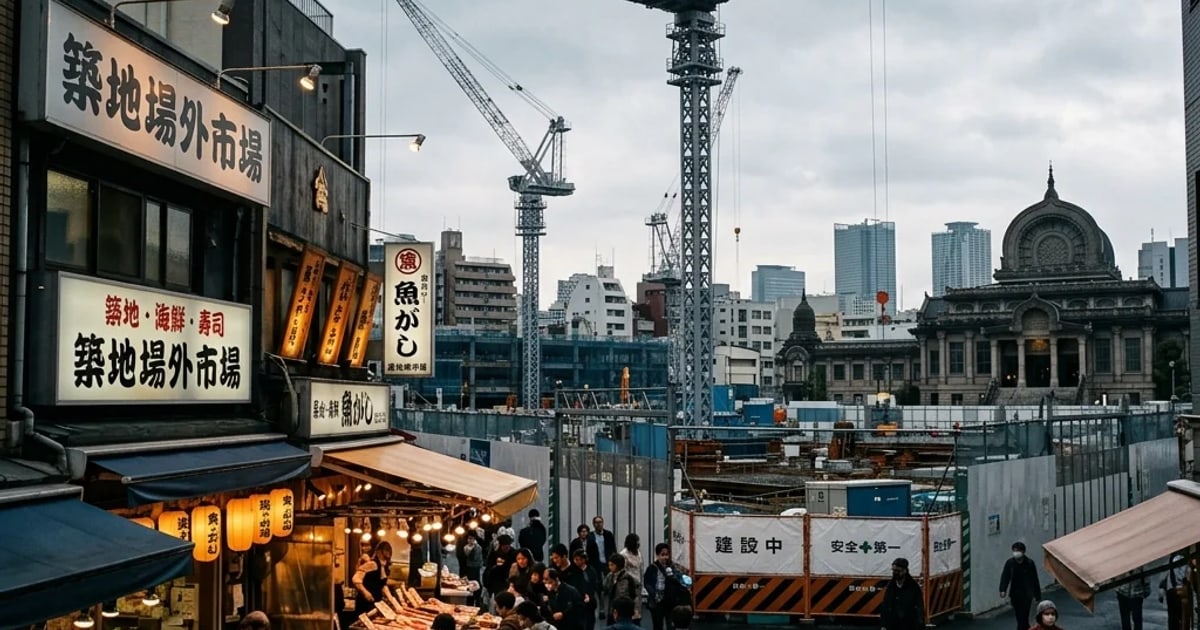
The site where the world’s greatest volume of seafood once changed hands stands completely empty. Vast. It’s hard to believe a space this large exists in the heart of Tokyo. Massive construction scaffolding and noise barriers mark its boundaries, and a few tower cranes rise into a grey sky.
In 2018, Tsukiji Market relocated to Toyosu. The place that had sustained Tokyo’s early mornings since opening in 1935 — 83 years in total — closed its doors. Since then, this land has effectively sat empty. A plot the size of four Tokyo Domes, right in the center of the city.1
Reading 400 Years on a Construction Barrier
A long timeline runs along the construction barrier. The kind that makes you stop.
In 1657, following the Great Meireki Fire, the Tokugawa shogunate reclaimed the coastal area here as part of Edo’s reconstruction. Tsukiji — literally “constructed land.” Built from the sea. Samurai families settled the new ground, and Namiyoke Inari Shrine was established.2
During the Meiji era, a foreign settlement took root. Established in Tsukiji in 1869, the settlement became the first gateway for Western culture entering Tokyo.
Then came the 1923 Great Kanto Earthquake. The Nihonbashi fish market was destroyed, and in 1935 Tsukiji Market opened as its replacement — the oldest of Tokyo’s eleven central wholesale markets, handling seafood and produce for nearly ninety years.3
Four hundred years of history stretched across one wall. Most passersby walked straight past. But read it, and you find yourself standing there longer than expected.
What Comes Next: 2030 and Beyond
The scale of what’s planned is staggering.
The centerpiece is an all-weather, multi-purpose arena with capacity for 50,000. Indoor facilities for sports, concerts, and large-scale exhibitions. Around it: MICE facilities, hotels, residences, a life sciences complex. Half the site will become waterfront parks and open space.
A consortium of eleven companies led by Mitsui Fudosan is investing approximately ¥900 billion. Target for Phase 1 opening: early 2030s.
Underground, a new subway station is planned. If the proposed new central Tokyo and waterfront subway line materializes, Tsukiji will become a transit hub connecting Tokyo Station, Ginza, Toyosu, and Haneda Airport. A water transportation hub is also on the drawing board.
The renderings on the barrier are spectacular. Gleaming towers over the water. Green parks. A caveat runs at the bottom — “This overview is based on content as of August 2025 and is subject to change, including design changes, depending on future discussions.” The sentence you always see in urban redevelopment plans.
The Outer Market Lives On
One block from the construction site, the atmosphere changes completely.
Monzeki-dori. Even after the wholesale market moved to Toyosu, this street remained. Tuna-bowl restaurants, seafood shops, long-established knife specialists. Still opening early in the morning. Tourists and locals mixed together on the pavement.
What happens to this street once the redevelopment is complete is an open question. How it coexists with the new development — or whether it gradually gets pushed out. A question that repeats itself across Tokyo’s redevelopment zones.
Construction Next to the Temple
Tsukiji Hongwanji stands right beside the construction site.
Its distinctive exterior, modeled on ancient Indian Buddhist architecture. Founded in 1617, with the current main hall completed in 1934.4 Construction scaffolding wrapped around both sides of the building. The temple itself is also under renovation.
Old things and new things simultaneously under construction. Perhaps the clearest picture of what Tsukiji looks like right now.
Tokyo Is Still Being Built
Living in Nihonbashi, I sometimes think about this. Tokyo is not a finished city — it’s a city that keeps making itself.
They filled in the sea to make land in the Edo period. Rebuilt after the Great Kanto Earthquake. Transformed again before the Olympics. When the arena opens in 2030, someone will stand before a new barrier and read a new timeline. And what is present now will be history then, posted on the wall.
The sky was a little overcast, but the outer market was full of foreign tourists. It makes sense when you think about it. On one side of the construction barrier, a future city is rising. On the other, shops that have been open for decades are doing business as usual. Old and new existing side by side — perhaps one of the reasons visitors to Tokyo never stop coming.
I walked home instead of taking the train. There were a few drops of rain, and then it cleared. A good walk.
June 2026, Tsukiji