![Japan Rental Contracts: Ordinary vs Fixed-Term Leases & Restoration [2026]](https://gsfark.com/assets/images/blog/tokyo-moving-contracts-two-notes-hero-og.jpg)
※ This article is for informational purposes only and is not investment, legal, tax, or immigration advice. Figures, rules, hours, and operational details were accurate when published—verify with official sources before you rely on them.
It’s easy to assume that once you’ve read a rental contract once, you’re done. In practice, what happens after move-in often matters more.
Before signing a rental contract in Japan, check three things first: whether it is an ordinary lease or a fixed-term lease, how restoration costs are allocated at move-out, and what upfront costs sit on top of rent. Contract wording can feel unfamiliar in Tokyo, so this note keeps to those essentials using Tokyo Metropolitan Government and MLIT guidance.
What feels unfamiliar isn’t the whole contract — it’s these three points.
This is not legal advice. Individual contracts and specialist review still come first.
How do ordinary and fixed-term leases differ?
The first thing to verify is the ‘type’ of contract.
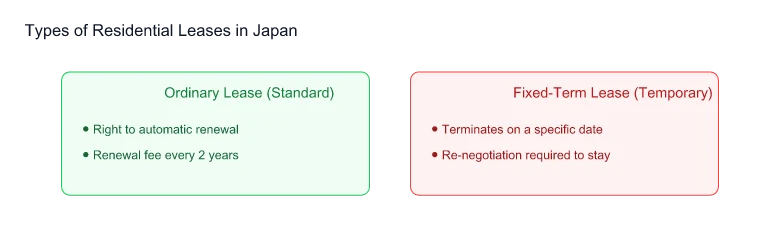
- Ordinary Lease (Futsu Chakuya): The most common type in Japan. It typically lasts for 2 years and automatically renews unless the tenant chooses to leave. For a landlord to refuse renewal, they must provide ‘justifiable grounds,’ which are very difficult to prove in court. This provides high security for the tenant. (Note: A renewal fee of ~1 month’s rent is common.)1
- Fixed-Term Lease (Teiki Chakuya): This contract terminates definitively at the end of the term. There is no right to renew. If you wish to stay longer, you must negotiate a new contract with the landlord, who has no legal obligation to agree. These are often used for high-end properties or temporary rentals.
Who pays for restoration at move-out?
The biggest source of conflict in Japan is the refund of the security deposit (Shikikin). Many assume “any wear means paying for a full replacement,” but the actual allocation depends on the cause.
- Tenant’s Responsibility: Damage caused by negligence or intent (e.g., wallpaper stains from smoking, mold due to poor ventilation, or deep scratches from heavy furniture).2
- Landlord’s Responsibility: Normal wear and tear or aging (e.g., faded wallpaper from sunlight, minor carpet indentations from furniture, or dust behind appliances).
- The 6-year guideline: MLIT guidance often treats wallpaper as having a useful life of about 6 years, with residual value discussed near ¥1 after that period. That does not mean every dirty wall after six years is free to replace; special clauses and the cause of damage still matter.3
How do guarantors work for foreign renters?
A common hurdle for foreigners is the requirement for a joint guarantor. Today, using a guarantor company (Hoshō Gaisha) is common. Some expect upfront costs to run one or two months’ rent, then find the actual estimate higher.
- Guarantor-company example: GTN (Global Trust Networks) is one firm that offers multilingual support. Approval and terms vary by company, visa, and income, so no single firm is always better.
- Initial Costs: Beyond monthly rent, many people prepare 4 to 6 times rent for Shikikin, Reikin, agent fees, insurance, and guarantor fees. Confirm the written estimate for each listing.1
Why record the apartment on move-in day?
The most helpful step on move-in day is to photograph and video existing marks. Emailing those files to the management company makes it easier to separate old wear from new damage at move-out.
At the time it felt like a tedious extra step. Later, it turned out to be the record that saved the most time.
What can you try to negotiate in the contract?
Tokyo leases are not always immovable. In slower seasons (January–February and July–August), or when a unit has sat empty, some terms can be adjusted. This article does not claim ward-by-ward acceptance rates.
Terms you can ask about
- Reikin (Key Money): Gift money of about 1–2 months’ rent. Some newer listings omit it. If it appears, ask through the agent whether a waiver or reduction is possible.
- Free Rent Period: On some higher-priced fixed-term leases, a 2–4 week rent-free period is offered instead of a rent cut.
- Special Restoration Clauses: Riders such as “¥50,000 cleaning on departure” or “full tatami replacement regardless of condition” are common. Ask about them in writing before signing, and compare with the Tokyo guidelines (Japanese and English).
Clauses that need careful review
Renewal and termination language is central to ordinary leases. If a contract says the landlord may end the lease at will without cause, ask the agent and a specialist before signing. This article does not declare any clause void by itself.
What should foreigners check before signing?
Foreign residents often need extra document checks because of language and paperwork. Review the list below before signing.
Document Verification
- Obtain the full lease in Japanese and English (or Korean). If there is no bilingual version, get a professional translation before signing.
- If needed, check ownership with a registry extract. Fees can vary by counter or online method, so confirm the Legal Affairs Bureau guidance.
Financial Verification
- Calculate total move-in cost in writing: Shikikin + Reikin + agent fee + insurance + guarantor fees. Some cases land around 4.5–6.5 months of rent.
- Confirm whether the guarantor company requires a Japanese co-signer. GTN and CASA are often mentioned, but this is not a recommendation of any firm.
Move-In Day Protocol
- Photograph and video existing marks before unpacking, then email the files to yourself.
- Test appliances. If something is wrong, report it in writing the same day. Verbal-only reports leave no record.
- Confirm trash rules and collection points.
One-line pre-signing check
- Contract Type: Confirm ordinary vs fixed-term, and read renewal/end terms.
- Restoration: Compare special clauses with Tokyo and MLIT guidance.
- Initial Cost: Confirm whether Reikin and guarantor fees appear on the estimate.
The contract ends with a signature. The living part starts after.

![Is Shin-Okubo Tokyo's Only Koreatown? Cultural, Support & Business Hubs [2026]](https://gsfark.com/assets/images/blog/tokyo-korean-community-beyond-shinokubo-hero-og.jpg)